Updated October 2026
The short version
Bathroom painting in Naperville, IL starts with the moisture: mildew is cleaned and killed, peeling paint near the shower is scraped back, and bare spots are primed before two coats of a moisture-resistant paint. A satin or semi-gloss finish handles wiping, and we check that the exhaust fan is pulling air, since steam is usually what made the old paint fail.
Why bathroom paint fails first
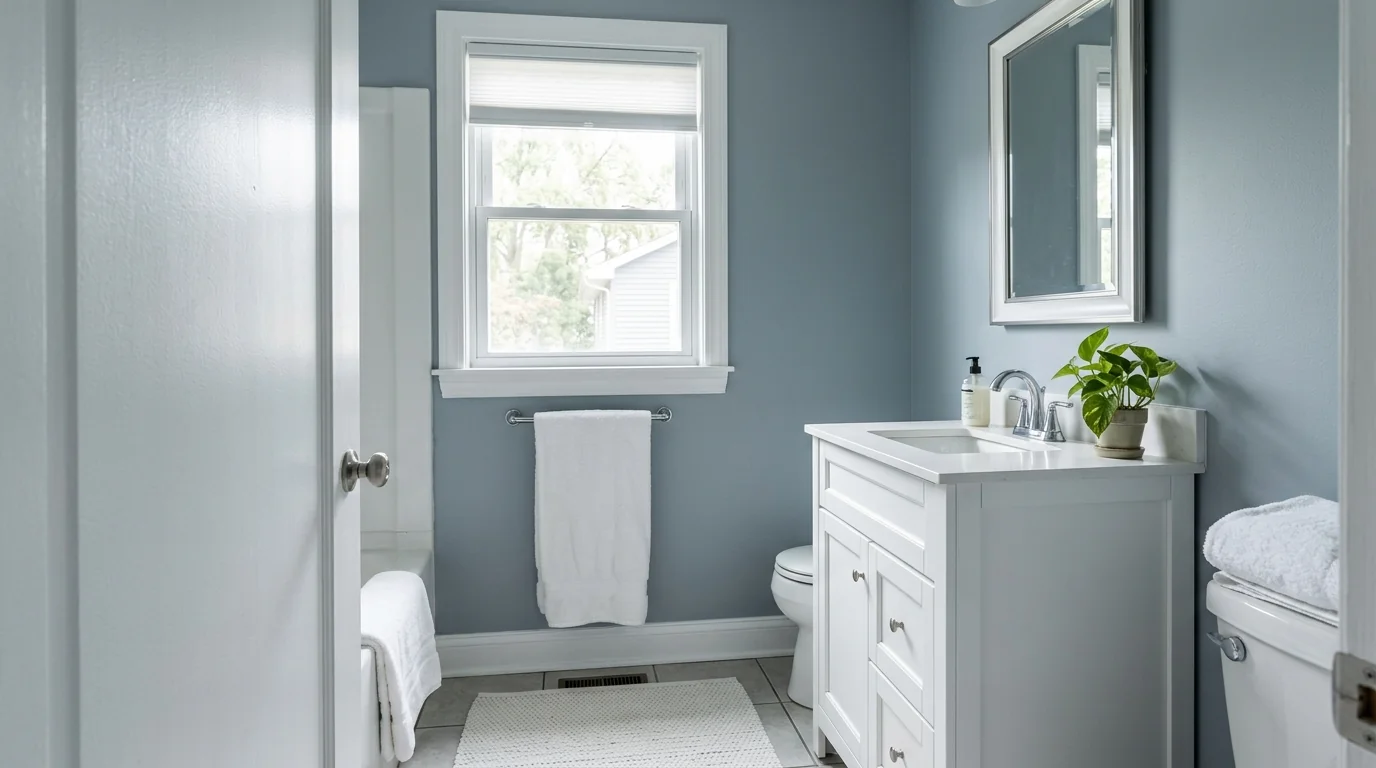
Bathrooms are the hardest room in the house on paint. Every shower fills the room with steam that condenses on the ceiling and the outside walls, and if the exhaust fan is weak or not run long enough, that moisture soaks into the paint film. The result is peeling over the shower, gray or black mildew spots in corners, and paint that wrinkles where water sits.
So repainting a bathroom is mostly prep. Mildew is cleaned and treated, not painted over; loose paint is scraped to a sound edge; and the room gets a primer and a paint made for high humidity, which resists mildew and holds up to wiping. Moisture-resistant bath lines from Sherwin-Williams and Benjamin Moore are made for exactly this room.
Choosing a sheen for a bathroom
| Sheen | Where it works | The trade-off |
|---|---|---|
| Satin | Most bathroom walls | Wipes clean, shows fewer wall flaws than semi-gloss |
| Semi-gloss | Trim, doors and high-splash areas | Most washable; highlights every dent and patch |
| Bath-specific matte | Powder rooms and low-steam baths | Softer look; only in lines rated for bathrooms |
What moves the price of bathroom painting
Bathrooms are small but slow, because of cutting in and prep.
- Mildew cleaning and peeling paint to scrape
- Ceiling repairs over the shower
- Cutting in around tile, tubs, vanities and mirrors
- Trim, doors and the vanity if included
- Removing and reinstalling fixtures and accessories
Mildew-Resistant Wall Finishes
Bathroom walls get a paint formulated for humidity, with mildewcides built in and a tighter film that resists moisture. Before it goes on, existing mildew is cleaned with a mildew cleaner and rinsed, because painting over live mildew lets it grow back through the new coat. We cut in carefully along tile, the tub surround and the vanity backsplash, where a sloppy line is most visible, and recaulk the gaps where walls meet tile or tub. Grab bars and towel bars are removed and reinstalled into solid backing.
Peeling Paint Near the Shower
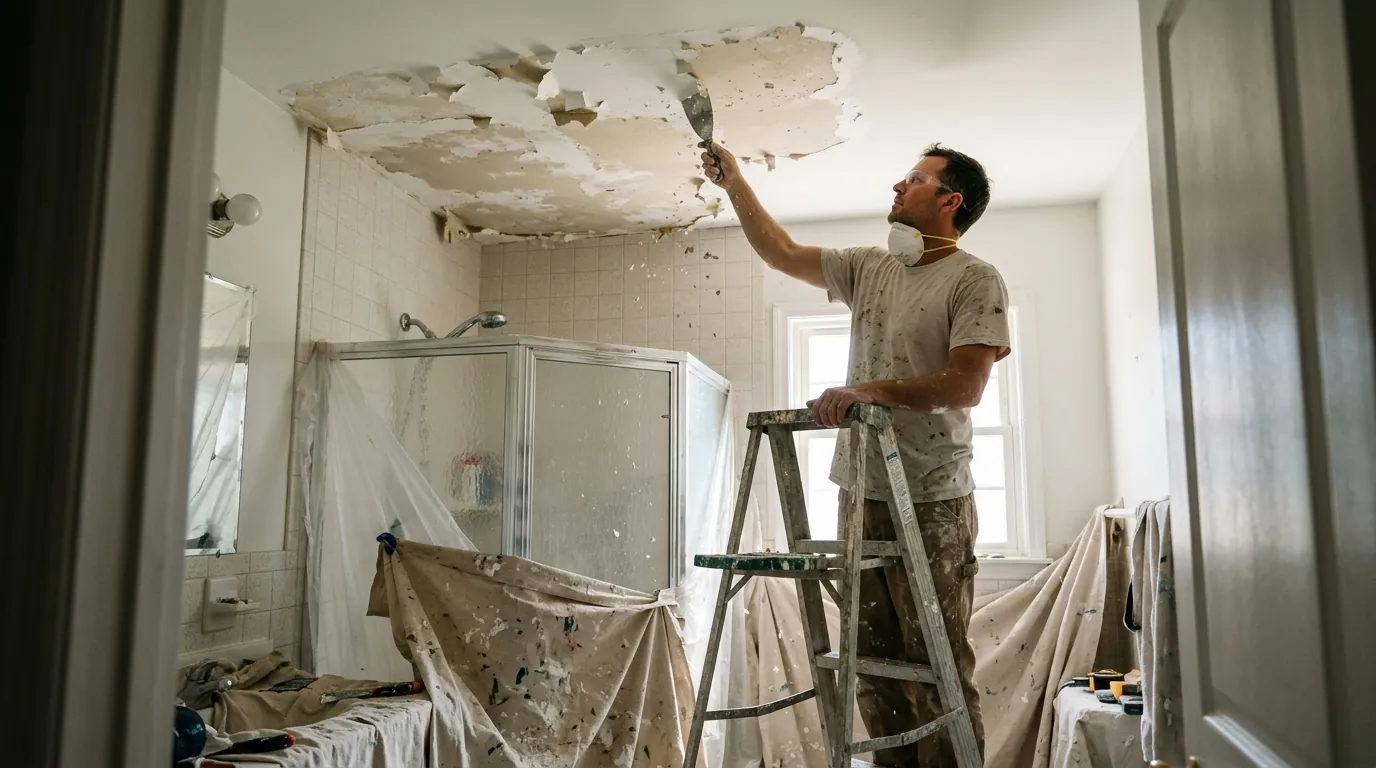
Paint that peels above and beside the shower has usually been pushed off by moisture. We scrape it back to a firm edge, sand the edges so they do not show through, and spot-prime the bare areas with a primer that bonds well in damp rooms. If the drywall behind it is soft or stained, that section is cut out and replaced first. Painting over a damp wall only restarts the same cycle, so we check before we cover. Window sills in bathrooms get the same scraping and priming, since condensation sits there.
Bath Ceilings and Vent Areas
The ceiling over the shower takes the most steam, so it is often the first surface to peel and spot. We clean and prime it, then paint it with a moisture-resistant ceiling finish rather than standard flat ceiling paint, which absorbs moisture. The area around the exhaust fan grille often shows staining; the grille is removed and cleaned while we paint. We also check that the fan actually moves air, since a weak fan is a common root cause. Light fixtures over the vanity are loosened so we paint behind them, not around them.
Bathrooms in Naperville's 1980s homes
With the typical Naperville house dating to 1986 at the 2000 census, many bathrooms here are on their third or fourth coat of paint and still have the exhaust fan the builder installed. Fans that have run for decades often move less air than they did new, which is why we check the fan whenever a bathroom has peeling paint or mildew, and tell you if it is worth replacing before we repaint.
What is included in a bathroom repaint
- Fixtures, mirror and accessories removed or masked
- Tile, tub and vanity protected
- Mildew cleaned and treated
- Peeling paint scraped and sanded
- Primer on bare and repaired areas
- Two coats of moisture-resistant paint
- Caulk renewed where walls meet tile
- Exhaust fan grille cleaned and airflow checked
How we repaint a bathroom
- 1
Protect and remove
Fixtures off or masked, surfaces covered.
- 2
Clean and treat
Mildew cleaned, room dried.
- 3
Scrape and prime
Peeling paint off, bare spots primed.
- 4
Two coats
Moisture-resistant paint on walls and ceiling.
- 5
Finish details
Caulk, fixtures back, fan checked.