Updated October 2026
The short version
Interior trim and door painting in Naperville, IL uses a hard enamel rather than wall paint, because baseboards and doors get kicked, scrubbed and handled. We fill nail holes and gaps, sand for adhesion, prime bare or stained wood, then brush and roll two coats. Stained oak trim going to white needs a stain-blocking primer so the tannins do not bleed yellow.
Why trim needs a different paint than walls
Wall paint is soft enough to touch up easily, which is exactly why it fails on trim. Baseboards take vacuum hits and shoes, door edges take hands, and casings get scuffed by everything carried through a doorway. Trim gets an enamel instead: a harder, smoother finish in satin or semi-gloss that wipes clean and resists chipping.
The prep is what people notice in the end. Every nail hole is filled, open miter joints and the gap along the top of baseboards are caulked, and glossy old finishes are sanded so the new coat grips. Brushed and rolled carefully, enamel levels out to a finish that looks factory-made.
Three kinds of trim enamel
| Enamel | Finish and feel | The trade-off |
|---|---|---|
| Waterborne alkyd | Hard, smooth, levels like oil | Slower to dry between coats |
| Acrylic enamel | Fast drying, low odor | A little softer; shows brush marks if overworked |
| Oil-based enamel | Very hard, classic look | Strong odor, yellows over time, slow cleanup |
What moves the price of trim painting
Trim is priced by the linear foot and the doors, not by room size.
- Linear feet of baseboard, casing and crown
- The number of doors and their style
- Stained trim that needs stain-blocking primer
- Caulking open joints and gaps
- Doors removed and sprayed versus painted in place
Published ranges, not our price. trim painting, Naperville: $500-$1,500 (source). These are area or national figures; we quote after we see the job.
Baseboards and Casings
Baseboards and door casings are the most-repainted trim in any house because they take the most abuse. We clean them, fill dents and nail holes, caulk the gap where baseboard meets the wall and the open miters at corners, then sand and spot-prime. Two coats of enamel finish them, cut in along the wall and floor so the line is straight. Carpet edges are tucked and masked so paint does not reach the fibers. Shoe molding is included where it meets the floor, since it takes the most mop and vacuum hits.
Six-Panel and Flat Interior Doors
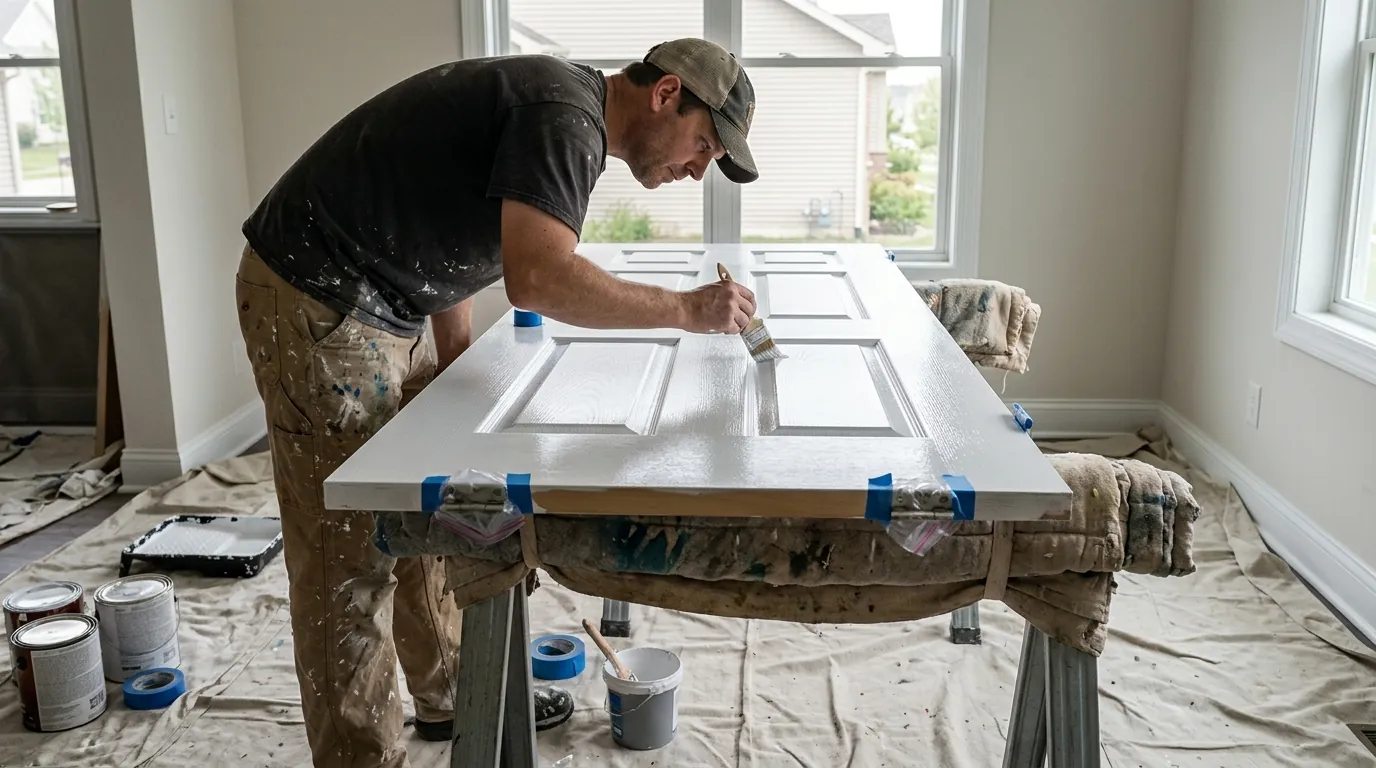
Doors are the most handled surface in a house. We take them down, lay them flat on padded racks and paint both faces and all four edges, which gives a smoother finish than painting doors on their hinges. Six-panel doors are painted in a set order, panels first, then rails and stiles, so lap marks do not show. Hinges and knobs are bagged and labeled by door, and each door goes back where it came from and is checked to close cleanly.
Crown Molding
Crown molding sits up against the ceiling, where caulk lines crack as the house settles and old paint yellows from years of heat and light. We recaulk the joints along the wall and ceiling, fill the corner miters and repaint it to match the rest of the trim. Crown is cut in by hand along both edges, since tape on a textured ceiling rarely gives a clean line. Adding fresh crown where there was none is carpentry we can quote separately.
Stained Oak Trim to Painted
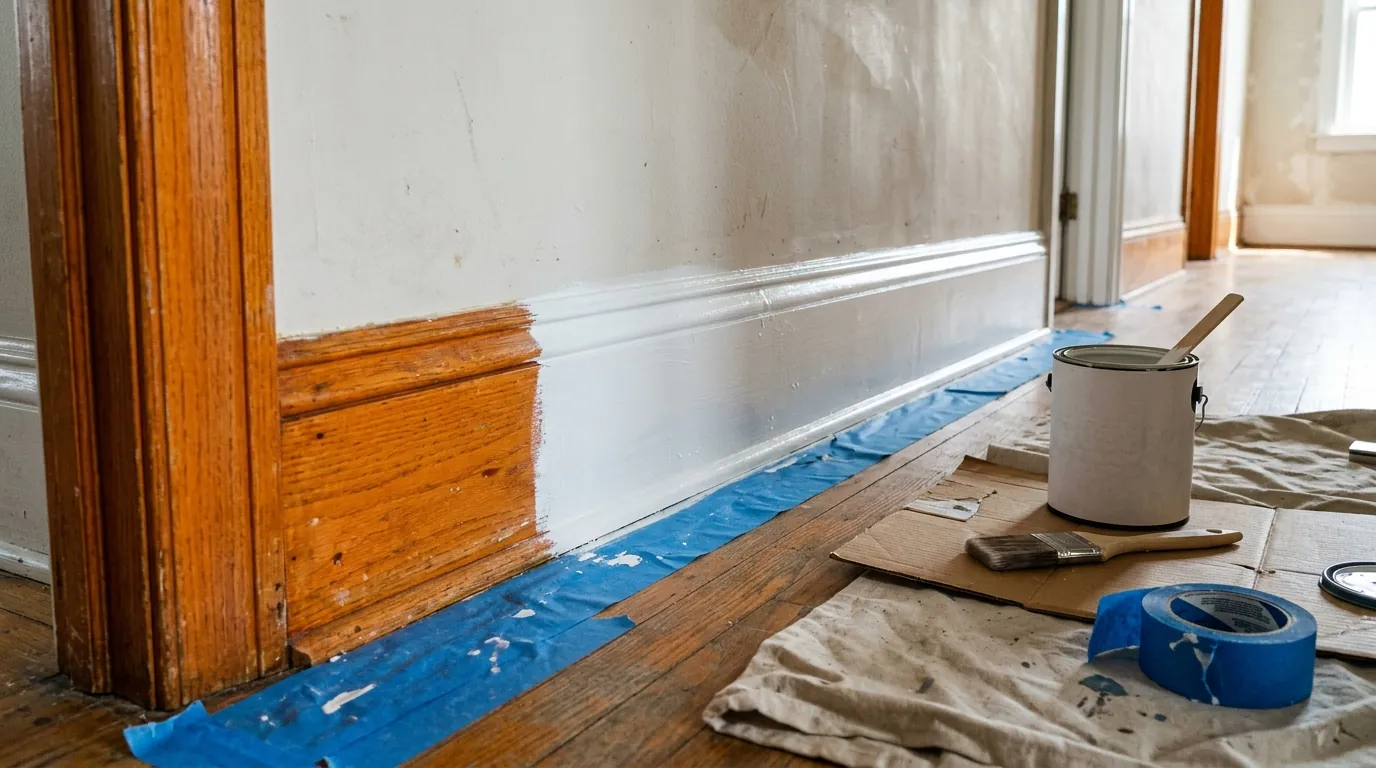
Painting stained oak trim white is one of the biggest changes you can make to a 1980s or 1990s interior. It takes more prep than a repaint: the clear coat is scuffed, and a stain-blocking primer goes on first, because oak tannins bleed through ordinary primer as yellow blotches. The open grain can be left to show or filled for a smooth look. Two coats of enamel finish it, and the whole house reads brighter. Window stools and aprons get the same treatment so the trim matches all the way around.
Oak trim in Naperville houses
On the District 203 side of Naperville about 71 percent of homes were built between 1970 and 1999, and a large share of them came with stained oak casings, baseboards and six-panel doors. Turning that trim white is the most common trim job we quote here, and it is why our estimates list stain-blocking primer as its own line instead of hiding it inside a per-foot price.
What is included in a trim and door repaint
- Floors and carpet edges protected
- Nail holes and dents filled
- Open joints and gaps caulked
- Glossy finishes sanded
- Stain-blocking primer on stained wood
- Two coats of enamel
- Doors painted flat, hardware bagged
- Doors rehung and checked
How a trim job runs
- 1
Protect
Floors, carpet edges and walls masked.
- 2
Fill and caulk
Holes filled, gaps and joints caulked.
- 3
Sand and prime
Gloss scuffed, stain-blocker on stained wood.
- 4
Two coats
Trim brushed, doors painted flat on racks.
- 5
Rehang
Doors back on, hardware reinstalled.