Updated October 2026
The short version
Penetrating deck stain usually beats paint on walking surfaces, because it fades instead of peeling and recoating is a wash and another coat. Most deck professionals recommend restaining every two to three years. Bob Vila's guide, citing Angi, puts a typical staining job at about $540-$1,250; stripping a failed finish adds about $1.50-$3 per square foot.
Three finishes compared
| Question | Penetrating stain | Solid stain | Deck paint |
|---|---|---|---|
| How it fails | Fades evenly | Can peel if applied thick | Peels and flakes |
| Wood grain | Visible | Hidden, texture shows | Hidden |
| Recoating | Wash and recoat | Wash, sand peeling spots, recoat | Scrape, sand, prime spots, recoat |
| Best on | Deck floors | Railings and vertical boards | Railings, some covered porches |
Why paint struggles on deck floors
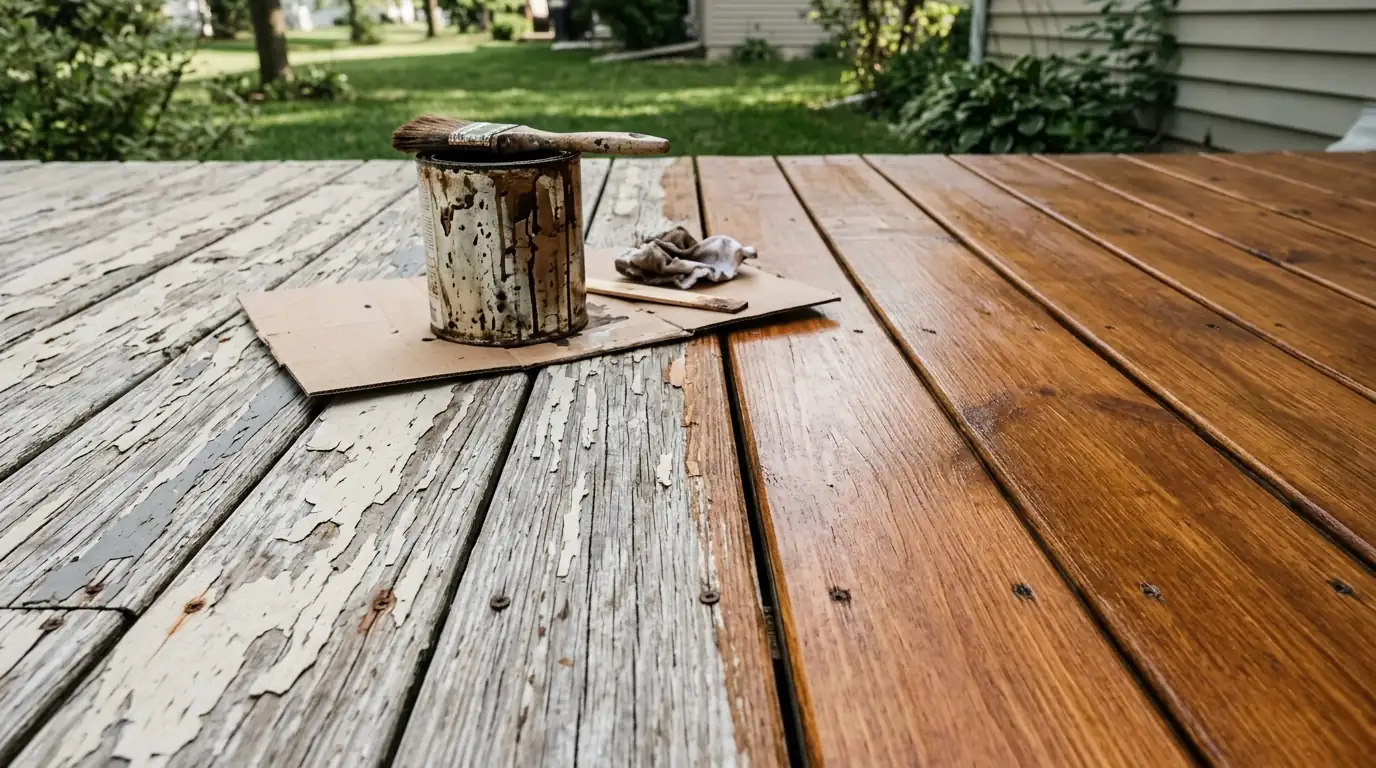
Paint forms a film on top of the wood. On a deck floor, standing water, foot traffic, sun and freeze-thaw cycles work at that film until it cracks and lifts, usually at the board ends and the busiest paths first. Once it peels, the only good fix is stripping it, which is slow and costs more than the staining itself.
Penetrating stain soaks into the wood instead. It wears down rather than peeling, so the next coat goes straight on after a wash.
The maintenance cycle
Most deck professionals recommend restaining every two to three years, sooner for decks in full sun. The simple test is water: splash the boards, and if the water soaks in and darkens the wood instead of beading, the deck is ready for another coat.
Railings and vertical boards wear more slowly than the floor, which is why many decks use a solid stain on rails and a penetrating stain underfoot.
What a proper restain includes
- Moving furniture and grills, and protecting plants and siding.
- Washing off gray wood, dirt and mildew with a deck cleaner.
- Brightening the wood so stain soaks in evenly.
- Letting the deck dry fully, usually a day or more.
- Resetting popped nails and loose boards.
- Applying stain to floor boards, rails and stair treads, a few boards at a time to avoid lap marks.
Skipping the wash or the dry time is the most common reason a fresh coat looks blotchy or wears out early.
When the old finish has failed
If a deck has peeling paint or thick, flaking stain, a new coat will not stick to it. The old finish has to come off first, which Bob Vila's guide prices at about $1.50-$3 per square foot for stripping, before the wood is brightened and stained. Loose boards and popped nails are fixed at the same time.
Slip, heat and comfort
Painted decks can be slick when wet unless an anti-slip additive goes into the final coat, and dark colors of any finish get hot underfoot in summer sun. Lighter stain tones stay cooler and show less dirt between cleanings.
If you want a painted look on a porch or a covered deck, choose a porch and floor enamel made for foot traffic rather than house paint, and plan on recoating the traffic paths more often than the edges.
Written by Gloria Fenwick, Painting Guides Editor at Call Tip Top. Figures in this guide come from the published sources listed below and are checked when those sources update.
Sources used in this guide: